

9io does not only track tokens. 9io tracks the wallets that found them early. While most tools show you what already pumped, 9io shows you who bought before the pump — and what those same wallets are buying now.
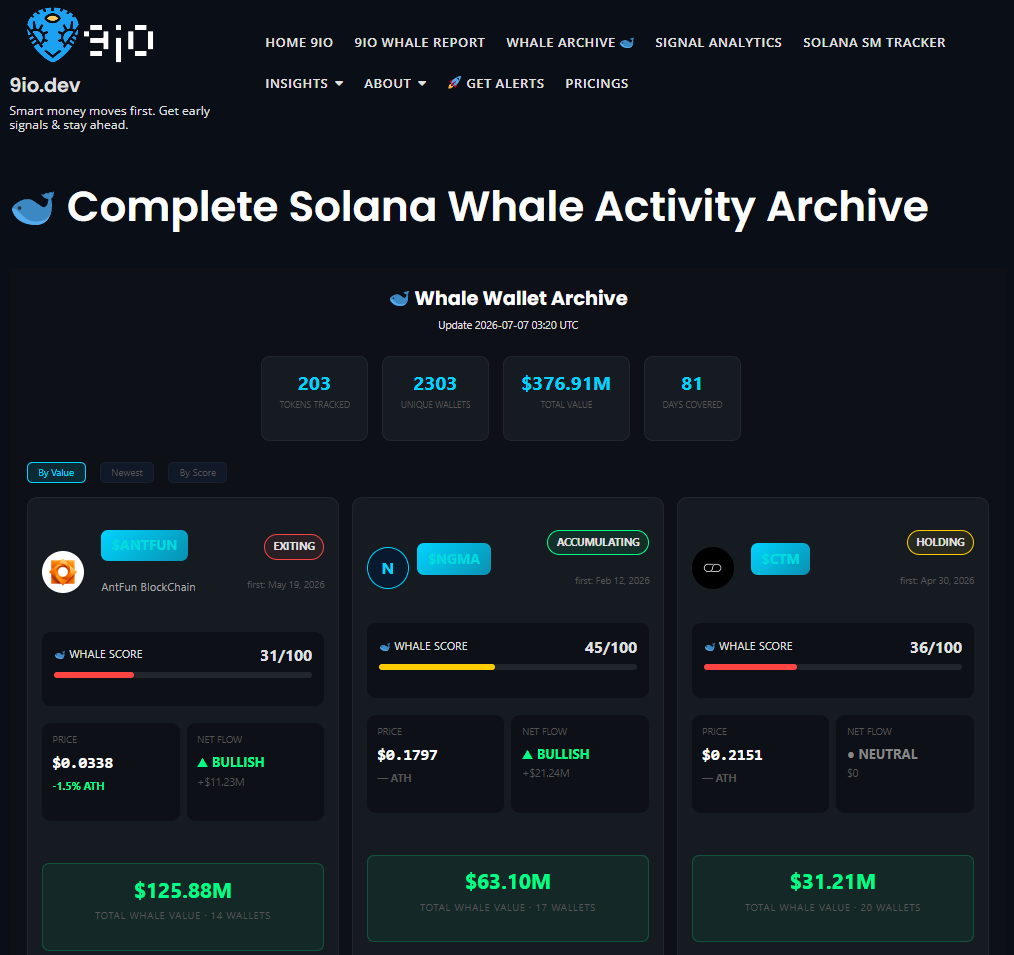
9io monitors 4,500+ Solana whale wallets daily, filters out bots and market makers, and surfaces the tokens that proven early-entry wallets are accumulating — before volume arrives and before the chart shows anything.
What Is Solana Whale Tracking?
Solana whale tracking means monitoring the on-chain activity of large and historically profitable wallets. Every buy, sell, and transfer on Solana is public — the problem is volume. Thousands of transactions per second make raw data useless without filtering.
That’s what a whale tracker does: it separates the wallets that matter from the noise.
Why a Chart Is Not Enough
A price chart tells you what happened. It never tells you who made it happen. Two identical green candles can mean completely different things:
- Smart money accumulating quietly before an announcement
- A market-maker bot wash-trading volume to attract retail
On the chart, both look bullish. On-chain, they look nothing alike. This is why wallet-level analysis beats chart-level analysis for early-stage Solana tokens — by the time the chart confirms a trend, the wallets that started it are often already exiting.
What Are Smart Money Wallets?
Smart money is not just “a big wallet.” A wallet holding $2M can be an exchange hot wallet, a DEX vault, a market maker, or a genuinely skilled trader. Only the last one is worth following.
9io classifies every tracked wallet by behavior, not just balance:
- Smart money — repeated early entries into tokens that later performed, clean exits near local tops
- System wallets (SYS) — bots, market makers, DEX vaults, and wash traders. 9io maintains a database of 1,100+ classified system wallets and filters them out of signals
- Exit wallets — wallets that fully exited a large position. What they buy next is one of the strongest early signals on Solana
Most trackers treat every large transaction as a signal. 9io treats wallet identity as the signal. A system wallet buying is often a contra-signal — it means retail is being invited in, not that smart money is accumulating.
How 9io Tracks Wallet Flow
9io runs continuous scans across its wallet database and combines three layers of intelligence:
- Gem scoring — every token whale wallets touch gets scored on liquidity, holder quality, safety checks, and whale overlap. Only tokens above the quality threshold surface as signals.
- Exit signal detection — when tracked wallets close out large positions, 9io flags it in real time. Exits often precede dumps by hours.
- Post-exit trails — after a profitable exit, 9io keeps following the wallet. Where recycled profits land next is where the next opportunity usually is.
Signals are delivered on the web, by email, and via Telegram for subscribers.
Start Tracking Solana Whales
Frequently Asked Questions
Is Solana whale tracking legal?
Yes. All Solana transactions are public on-chain data. Whale tracking simply organizes and interprets information anyone can access.
Can whale tracking predict token prices?
No tool predicts prices. Whale tracking shows you what experienced, well-capitalized wallets are doing — which is context, not a guarantee. Always do your own research.
How is 9io different from a large-transaction alert bot?
Transaction alerts fire on size alone. 9io fires on who is transacting — filtering out bots, market makers, and DEX vaults so signals reflect real trader behavior.
How many wallets does 9io track?
Over 4,500 whale wallets monitored daily across 180+ tokens, 1,200 wallets tracked in real time, and every wallet archived permanently.